
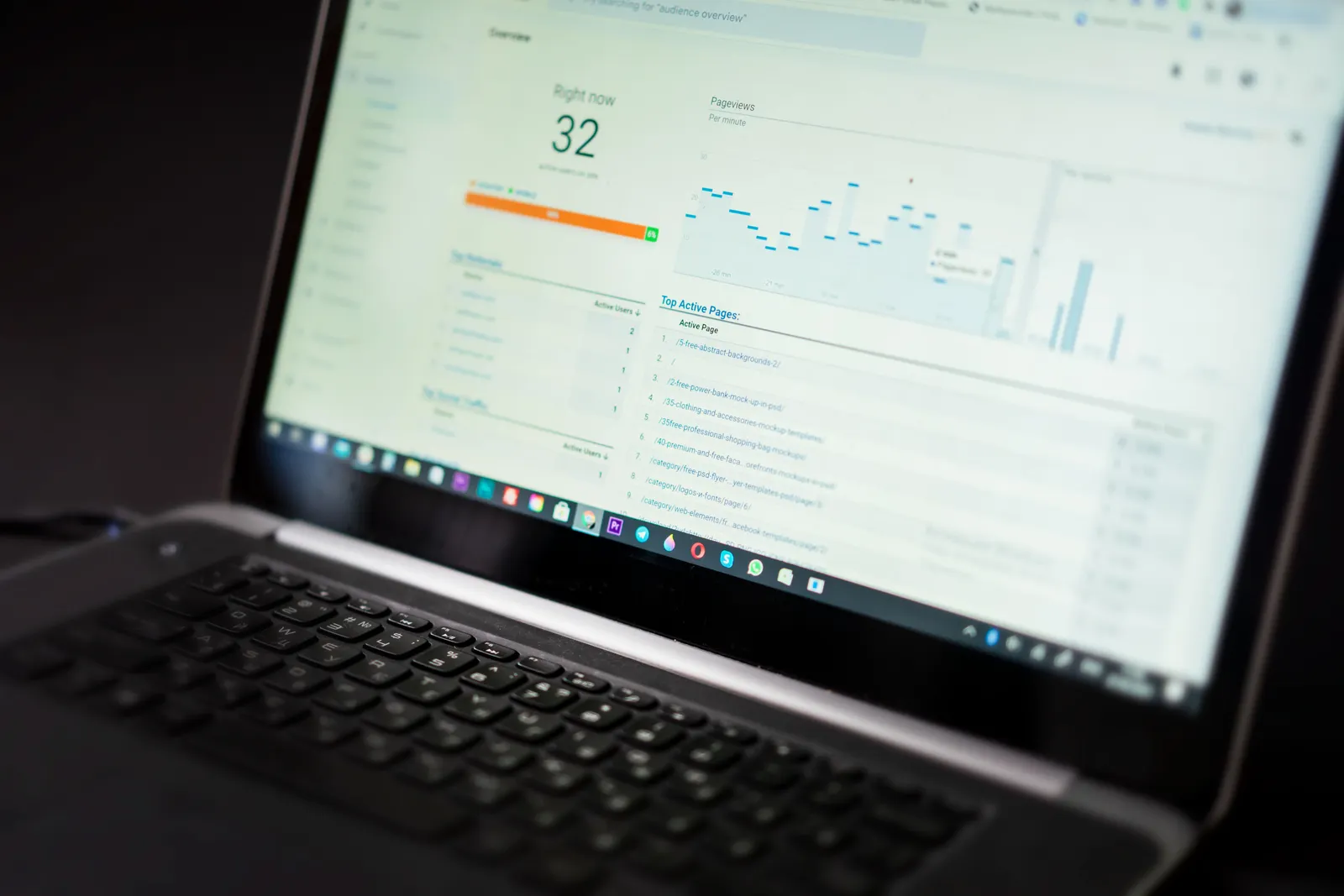


Track AI traffic through your analytics source data, then connect confirmed enquiries to your CRM or sales records. Keep three things separate: visits attributed to an AI source, actual enquiries received, and qualified opportunities or customers. A citation is not a visit, and a WhatsApp button click is not a lead.
You will not identify every AI-assisted journey. Someone can read a recommendation, search your company name later and call without clicking the original link. The useful goal is a dependable account of the evidence you can capture, with unknown sources left visible.
Start with session source in GA4
In Google Analytics 4, open Reports → Acquisition → Traffic acquisition, then select Session source / medium. Your navigation may differ if reports have been customised. Search the source rows for the AI platforms you want to investigate and inspect their actual values. Google's Traffic acquisition guide.
Start with recognisable sources such as chatgpt.com and perplexity.ai, checking what your property actually records. Do not restrict the investigation to the default Referral channel: source, medium and channel grouping are different fields, and tagging can affect classification.
Use Session source when asking which sources are credited with visits. Use First user source for the source credited with the user's first acquisition. The latter does not become ChatGPT simply because an existing visitor later arrives through ChatGPT. Unprefixed event-level attribution answers another question about credit for key events. Google's explanation of traffic-source scopes.
Keep the report's date range, property and dimension scope consistent. Compare sessions with sessions rather than quietly switching to users between months.
Build a checked AI source group
Save a filter or create a custom channel group once you understand the raw values. Prefer explicit source matches or carefully tested domain patterns to a catch-all rule containing “ai”. That substring can catch unrelated traffic.
Maintain a dated list of included sources, inspect unmatched rows and check rule order. GA4 custom channels use the first matching rule; an earlier broad channel can capture traffic before your AI rule does. Custom channel groups.
An AI-looking source is attribution evidence, not proof that an assistant independently recommended the business. Exclude your own tests from commercial reporting and distinguish known campaigns or shared tagged links from organic discovery where you can.
Test the route from the AI link to your website
OpenAI's publisher guidance states that ChatGPT automatically adds utm_source=chatgpt.com to referral URLs from its search results. This is useful, but it does not establish that every app, browser journey or analytics implementation will preserve the same source and medium. OpenAI's publisher FAQ.
With an authorised tester, follow a real link to your website and check:
- The destination and any redirects load correctly.
- Available referral or campaign information survives the route to the landing page.
- Your analytics implementation records the visit under the tested consent conditions.
- The intended enquiry action is recorded only when it actually occurs.
- The business receives the enquiry, with available source information preserved in the agreed sales system.
Test English and Arabic routes where you use both, mobile contact buttons, and separate booking domains where relevant. A Dubai supplier might have an English product page, an Arabic enquiry form and a WhatsApp conversation handled by sales; all three need to work together.
Record test enquiries so the team can remove them from lead totals. One successful test establishes that the tested route works, not that tracking captures every customer or device.
Define an enquiry before marking a key event
GA4 lets you designate an important collected action as a key event. That label does not establish lead quality or prove the business received a message. Google's key-event definition.
Agree the meaning of each action:
- A form-button click is an attempt; a successfully received form is a submission.
- A WhatsApp click opens a contact route; a received conversation is an enquiry.
- A telephone-link click is different from a connected call and a qualified sales call.
- A booking request is different from a confirmed appointment or paid order.
Configure successful-submission tracking where technically supported and test it against actual receipts. Do not assume an automatically collected form event proves delivery. Track useful contact clicks separately, with names that preserve their limited meaning.
In reports, select the relevant lead event rather than treating the total of all key events as lead count. Newsletter sign-ups, downloads and enquiries should not become interchangeable simply because all matter to the business.
Reconcile the visit, enquiry and sales outcome
Use a lead record to preserve the enquiry date, service requested, contact route, available acquisition evidence and subsequent status. Keep original source data alongside any reporting category so that a later rule change does not erase the evidence.
A useful attribution rule might credit the first recorded source associated with a lead, or the last recorded source before enquiry within a stated window. Choose and document the rule. Neither reveals an unobserved first discovery, and neither necessarily matches every GA4 report.
Join records only through a valid, authorised implementation. Matching daily totals or similar timestamps is not enough to prove that a particular visitor became a particular customer. Keep unmatched enquiries rather than forcing a source onto them.
For a Dubai business, qualification should include whether the requested service and actual service area fit. A genuine enquiry about a service you do not offer is still an enquiry, but should not be presented as a qualified opportunity.
A worked reconciliation
Consider a hypothetical Dubai office-furniture supplier reviewing a set of form events associated with recorded ChatGPT-source visits. This is a teaching example, not a Lunasol result or market benchmark.
The implementation provides a valid way to reconcile these events with submissions. The review finds:
| Record | Count | What the business can say |
|---|---|---|
| Recorded form events | 12 | Three extra events came from duplicate firing |
| Actual received submissions | 9 | One was an internal test and one was spam |
| Distinct genuine enquiries | 7 | The remaining seven were from different prospects |
| Qualified opportunities | 5 | Five met the agreed service and delivery-area criteria |
| Won orders by the reporting date | 2 | Two of those five had become orders; the others remained open |
The arithmetic is 12 − 3 = 9 submissions, then 9 − 1 − 1 = 7 genuine enquiries. The report should not claim 12 ChatGPT leads or seven customers. It should show the seven enquiries, five qualified opportunities and two orders, with the attribution rule and reporting date attached.
If one prospect later messages through WhatsApp, add that conversation to the existing lead where the match is established. Do not create another unique lead merely because the contact channel changed. Keep order value, collected payments and profit separate if you extend the report into financial performance.
Ask customers how they found you
A short optional “How did you first hear about us?” field or sales question can reveal journeys the website cannot observe. Include a free-text option and preserve the customer's answer separately from analytics attribution.
A customer might report ChatGPT while the recorded enquiry visit is credited to Google. That is useful evidence of possible earlier influence, not a reason to overwrite the original visit source.
Report tracked-source enquiries and customer-reported AI discovery separately. If presenting a combined count, deduplicate the lead records and show the overlap. Otherwise, one customer can be counted twice.
Keep names, email addresses, phone numbers and message contents out of GA4 event parameters and tracking URLs. Google prohibits sending personally identifiable information to Analytics. Store necessary sales details in the appropriately controlled business system and respect the consent and privacy requirements applicable to your implementation. Google's Analytics privacy guidance.
Understand what remains unmeasured
Direct traffic can include visits without usable referral information. It is not a hidden AI bucket you can recover by applying an assumed percentage. Redirects and tracking restrictions can also affect source capture. Google's direct-traffic explanation.
Likewise, do not relabel all Google organic visits as AI Search. Google's dedicated Generative AI performance report provides link impressions for supported AI Overviews and AI Mode experiences; those impressions do not identify which CRM lead clicked an AI answer. Google's report documentation.
A referral normally does not reveal the customer's complete prompt or every earlier answer they read. Crawler requests are not human visits. A rise in direct traffic, branded searches or sales after GEO work is worth investigating, but timing alone does not prove an AI contribution.
Give the business a report it can act on
Report recognised AI-source sessions and landing pages alongside confirmed enquiries, qualified opportunities and later sales outcomes. Show raw counts, the period, attribution rules and unmatched records. For long sales cycles, follow the same enquiry cohort forward instead of dividing this month's closed orders by this month's new enquiries.
Then act on the break in the journey. Visits without enquiries may point to poor fit or a weak contact route. Enquiries without qualified opportunities may point to misleading content or the wrong audience. Qualified opportunities without sales require a commercial review, not automatically more AI content.
Lunasol's GEO work connects priority customer questions with content and business-information improvements. When commissioning it, agree which referral and conversion analysis your existing access permits, and who will implement any missing website or CRM connections. A useful engagement connects the visibility work to business outcomes without promising to identify every AI-assisted sale.