
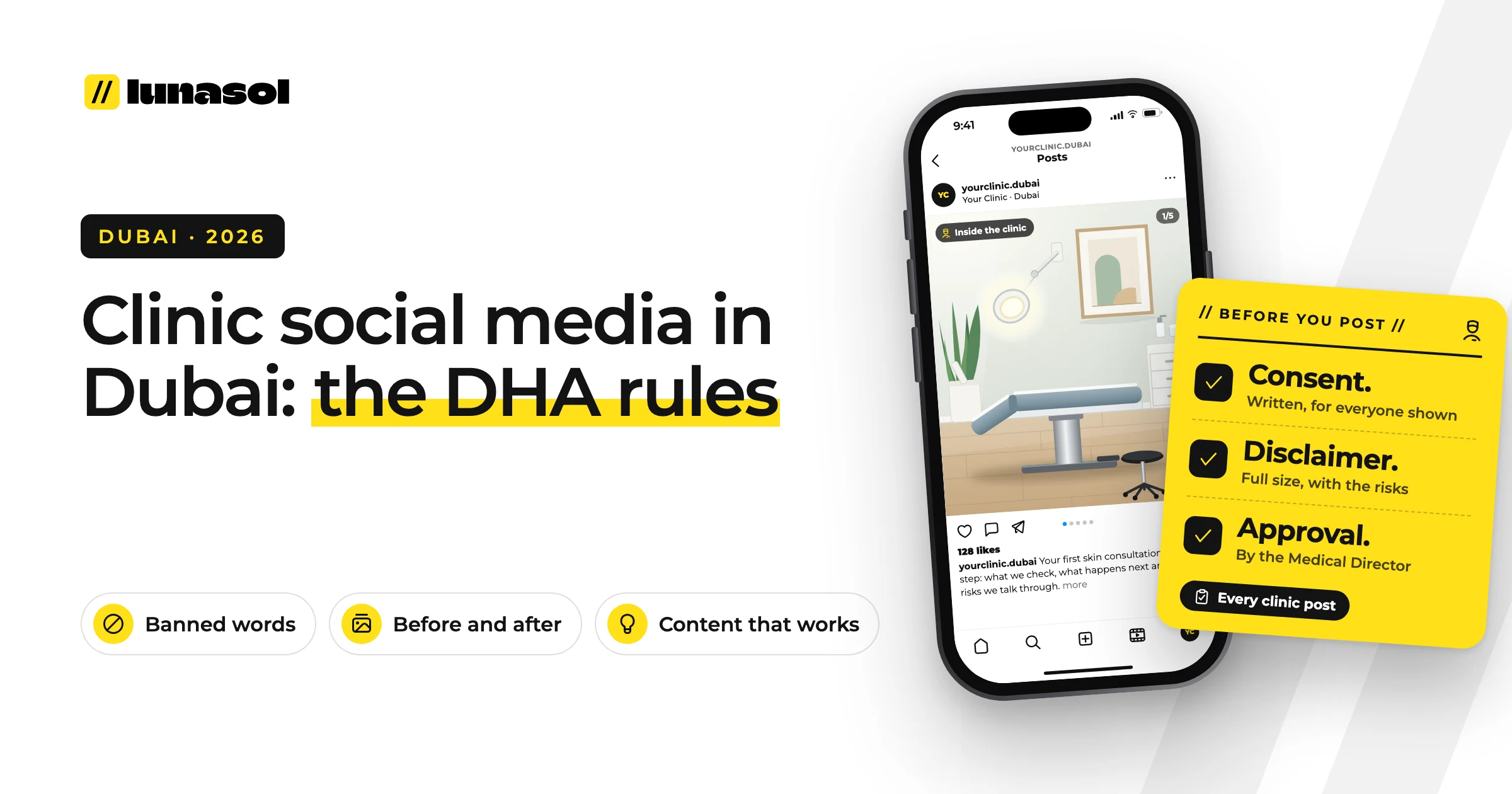


Clinic social media in Dubai follows the Dubai Health Authority (DHA) Standards for Medical Advertisement Content on Social Media. Your Medical Director approves posts that name the clinic, patients give written consent, before-and-after photos carry a results disclaimer, and words like "the best" or "100%" are out. Clear, factual content is what brings patients in.
A patient finishes a treatment, loves the result, and sends your front desk a selfie with three heart emojis and "you can post this". Your marketing brain says yes, right now. Your Medical Director's raised eyebrow says not so fast.
The eyebrow is right, and this guide explains why. It's how we'd brief a clinic as a healthcare marketing agency in Dubai: what the DHA standard actually says, in plain English, and the content that still works well inside it.
Please note: this is a plain-English summary of DHA's published standard, written for marketers. It isn't legal advice. Rules change, so check with DHA (or your own regulator) before you publish anything you're unsure about.
Which DHA rules apply to clinic social media in Dubai?
The main document is the DHA Standards for Medical Advertisement Content on Social Media (code DHA/HRS/HPSD/ST-21, version 1.1, 2022). It applies to all DHA-licensed health facilities and healthcare professionals that advertise on social media.
DHA sent it again to all private-sector facilities and professionals in Dubai in a circular dated 17 August 2026 (reference CIR-2026-00000144). The circular says failure to comply will lead to "suitable disciplinary actions".
The standard's definition of social media is broad. It names Facebook, Instagram, YouTube, Snapchat, LinkedIn and WhatsApp among others, so your Stories and WhatsApp broadcasts count too.
Two scope points before you go further:
- The standard says UAE federal and local laws also apply, and where they conflict with it, the law wins.
- It lists the Dubai Healthcare City Regulatory Authority as a separate authority. If your clinic is licensed in Dubai Healthcare City, check its own rules too.
Do clinic posts in Dubai need DHA approval?
The standard puts the sign-off inside your clinic. The Medical Director approves any social media content that uses the clinic's name or location, whether a doctor, an admin team member or an influencer posts it (sections 5.3 and 5.4).
The Medical Director is also accountable for the content and style of posts on any account that promotes the clinic (section 7.3). That's why "the agency posted it" won't work as an excuse, and why a good agency builds review time into every calendar.
Three more account-level rules from the standard:
| Rule | What the DHA standard says | Section |
|---|---|---|
| Licence number on the profile | The clinic's official account must state its medical advertisement licence number issued by the Ministry of Health and Prevention (MOHAP) | 5.2 |
| No DHA logo | Don't use the DHA logo or name, or any other government authority's, without explicit written approval | 7.2 |
| Keep an archive | Archive posts with their edits and formats, because DHA's Health Regulation Sector may audit them | 7.1.13 |
The standard doesn't set out how to get the MOHAP licence or what it costs, so ask DHA and MOHAP directly which licence applies to your facility.
What can a clinic not post? The DHA red lines
The standard's Appendix 2 lists 14 types of prohibited social media content. Here are the ones clinics trip over most, in plain words:
| Don't post | Where it comes from |
|---|---|
| Treatments that "guarantee" full recovery, or results that are "always effective" | Appendix 2, items 3 and 11 |
| Words that cause fear or make people think they have a serious disease | Appendix 2, item 10; section 8.1.14 |
| Anything that identifies a patient | Appendix 2, item 6 |
| Patient testimonials without written consent | Appendix 2, item 8 |
| Comparisons with other treatments, unless backed by peer-reviewed evidence | Appendix 2, item 9 |
| Trial use of medical products or services | Appendix 2, item 4 |
| Filming patients during surgery under general anaesthesia for promotion | Appendix 2, item 14; section 9.7 |
Section 9.7 goes further: no filming or live streaming for promotion while a patient is in minor or major surgery, under general anaesthesia, or in procedure rooms. So a live Reel of a patient's procedure is out.
Prices need care too. The standard's list of unacceptable content includes price information that's inaccurate, hides conditions, or offers time-limited discounts that can't be met (Appendix 1).
The banned words list
Section 6.11 gives 21 example words and phrases that must not be used, and says the list is "not limited to" these. They include:
- "the best", "the only", "unique", "exclusive", "one of a kind"
- "safest", "has no side effects", "100%", "absolutely certain", "assured success"
- "magic", "miraculous", "immediate results", "get money back"
- "famous", "pioneer", "very limited quantity"
Practitioners also can't claim their services are better than another doctor's or clinic's (section 8.1.9). It's an easy rule to break by accident, because marketing copy reaches for "best" out of habit.
Titles: "Dr." and "aesthetic consultant"
Staff must use the titles on their DHA licence. The standard specifically rules out titles such as "Aesthetic Specialist", "Cosmetologist" or "Anti-Aging Consultant" when they differ from the licence (section 6.1).
The "Dr." prefix is for physicians, dentists and other healthcare professionals who hold a recognised PhD (section 6.2). Check every caption, bio and on-screen name against the licence before it goes out.
Before-and-after photos and testimonials: what the standard allows
Both are allowed, with conditions. This is where clinics most often get it half right.
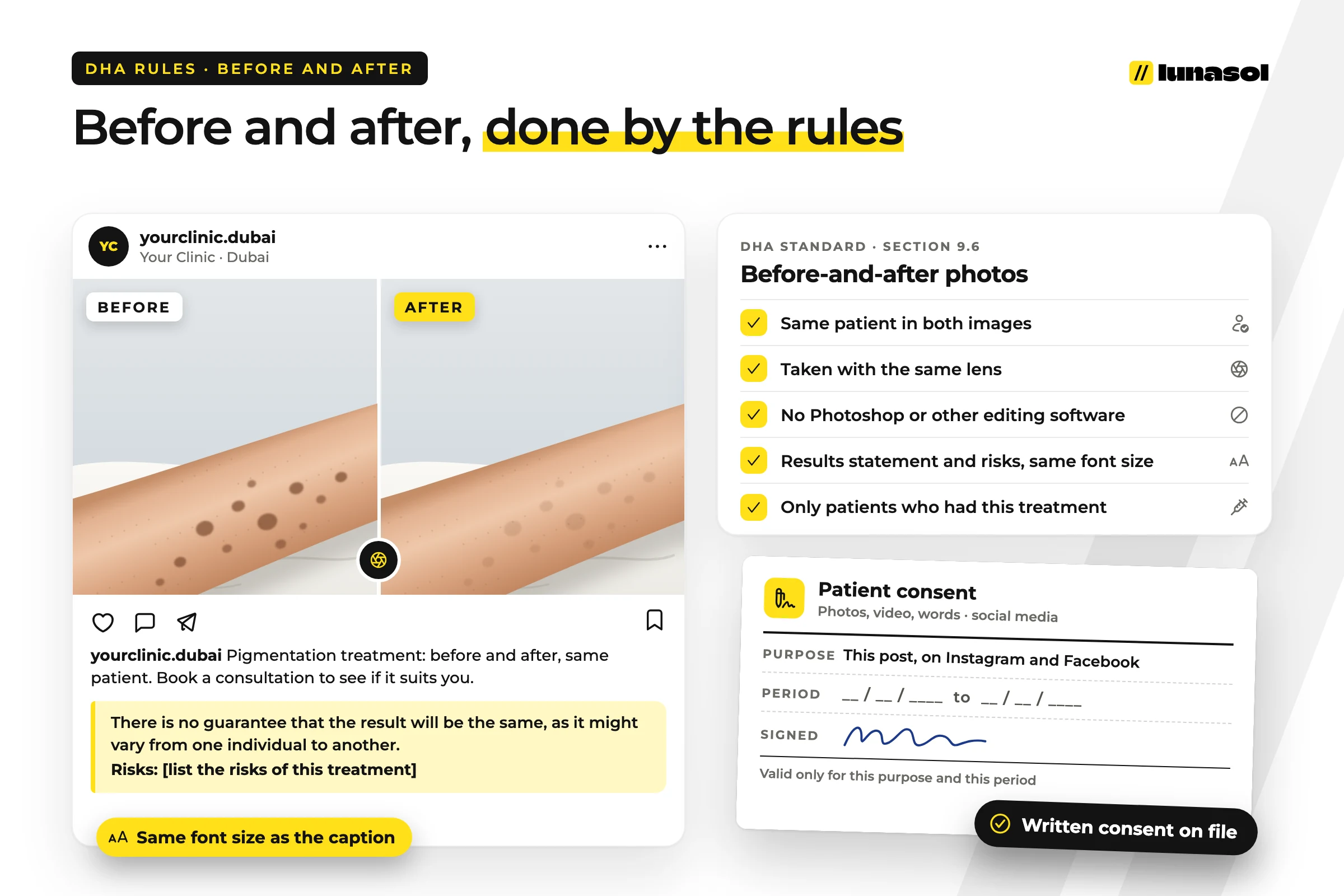
Before-and-after photos (section 9.6 and Appendix 2, item 12):
- Same patient in both images, taken with the same lens.
- No Photoshop or other editing software.
- A statement that there's no guarantee of the same result because results vary between people, plus the risks. Use the exact wording in section 9.6.
- That statement goes in the same font size as the rest of the post. No tiny grey text in the corner.
- Only patients who actually received that treatment.
Testimonials and anyone shown on camera (sections 6.10, 8.1.12 and 9.1):
- Get written, documented consent from every patient or person whose picture, video or words you use.
- Consent covers only the purpose and the time period it was given for. A yes for one Reel isn't a yes for a billboard next year.
- For patients under 18, get verifiable consent from a parent.
- Don't use testimonials that compare different regulated health professions (Appendix 1).
Back to that selfie at the front desk. With signed consent that covers social media, no editing, and the disclaimer in full-size text, it can be a perfectly good post. Without them, it stays in the chat.
Influencers, doctors' personal accounts and paid partnerships
The clinic is liable for content filmed on its premises, whether it's shot on a professional camera or a phone, and whether it's posted on the clinic's account, a doctor's account or an influencer's account (section 5.5).
Other points from the standard worth putting in your influencer brief:
- Influencers who name the clinic or its location need the Medical Director's approval of the content (section 5.3).
- Any paid or material relationship must be transparent, documented and disclosed to patients (section 6.7).
- Healthcare professionals keep separate personal and professional accounts (sections 7.1.2 and 8.1.1).
- Patients treated at DHA-licensed facilities shouldn't appear on a clinic's or doctor's international accounts (section 7.4).
Creators may also need a UAE advertiser permit from the National Media Authority (NMA). We cover who needs one in our guide to the UAE advertiser permit for business Instagram.
What content brings in patients (and fits the rules)
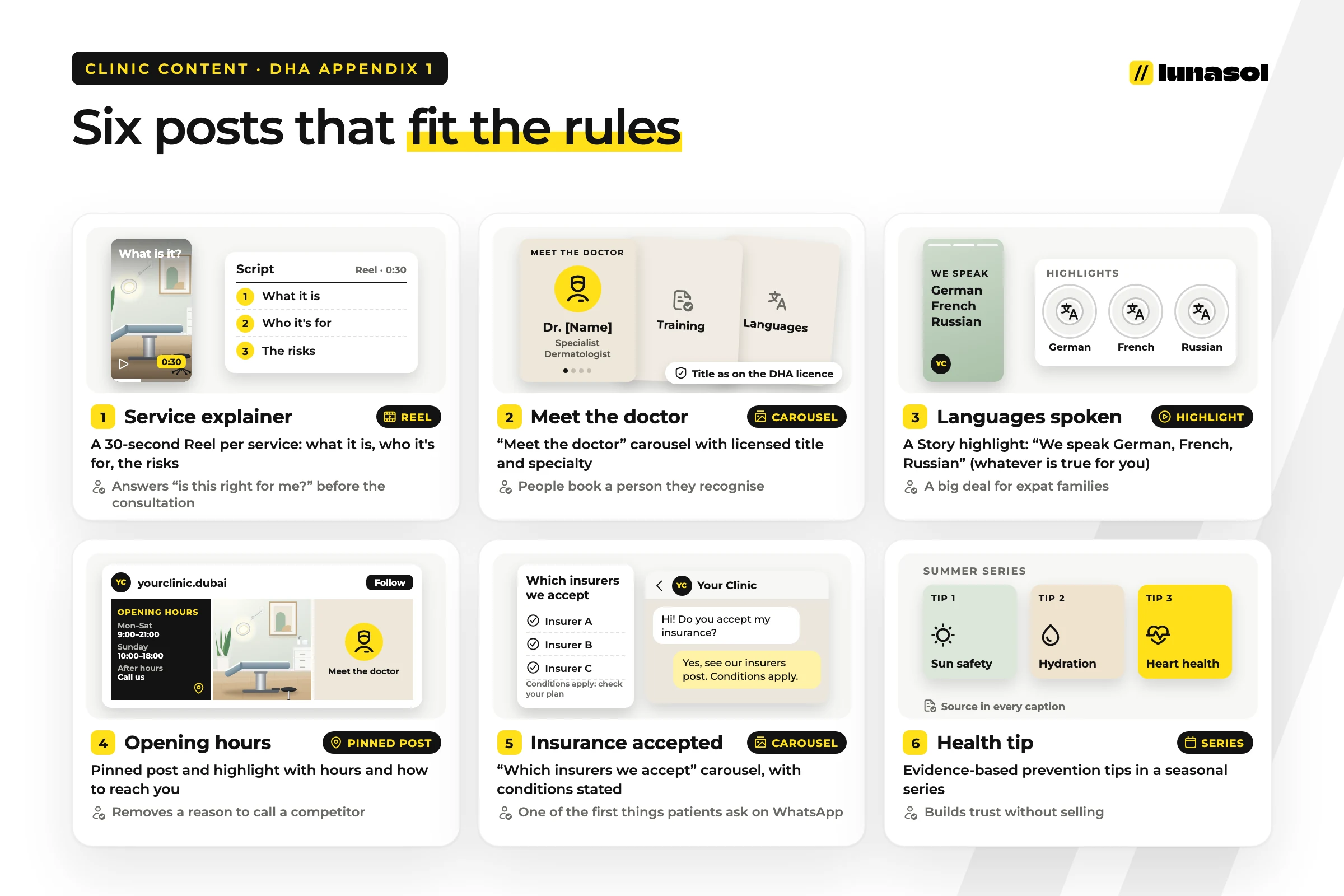
Here's our opinion: the DHA rules are less of a cage than they look. Appendix 1 of the standard lists 16 types of acceptable content, and most of them are exactly what a patient wants to know before booking.
| Acceptable under Appendix 1 | Content idea | Why patients care |
|---|---|---|
| A factual, clear statement of your services | A 30-second Reel per service: what it is, who it's for, the risks | Answers "is this right for me?" before the consultation |
| Practitioners' qualifications, training and DHA-recognised titles | "Meet the doctor" carousel with licensed title and specialty | People book a person they recognise |
| Languages spoken other than English | A Story highlight: "We speak German, French, Russian" (whatever is true for you) | A big deal for expat families |
| Office hours and after-hours availability | Pinned post and highlight with hours and how to reach you | Removes a reason to call a competitor |
| Fees and insurance arrangements | "Which insurers we accept" carousel, with conditions stated | One of the first things patients ask on WhatsApp |
| Public health information | Evidence-based prevention tips in a seasonal series | Builds trust without selling |
Two more patterns that fit the standard:
- Answer real questions. Ask reception for the 10 questions they hear most, then answer one per post. The standard asks for information that is truthful, accurate, concise, up to date and easy to understand (section 8.1.4), which is also a decent definition of a good caption.
- Show the place and the people. A calm walk-through of the waiting room, the consultation room and the team at work (with each team member's consent on file), without patients or private information in shot, builds familiarity without touching the filming bans.
And state the risks. The standard requires posts about outcomes to include the associated risks (section 6.6). A short line in the caption and on screen does the job and frankly makes you look more trustworthy.
A simple approval workflow for clinic social media
The standard asks the Medical Director to name trained people to moderate social media, train staff, keep clear policies and archive posts (sections 7.1.8 to 7.1.13). In practice, that becomes a short routine:
- Plan the month. Calendar, scripts and captions drafted together, with titles checked against DHA licences.
- Check consent. Written consent on file for every patient or person who appears, covering this use and this period.
- Medical Director review. Approval of scripts before filming and of final edits before publishing.
- Film. Away from procedure rooms during treatment, with no patient details on screens or paperwork in shot.
- Publish and archive. Save each final post with its edits, so you can show it if DHA audits.
- Moderate comments and DMs. Move health questions out of public comments; the standard asks clinics to avoid social media discussions where patients may disclose health information (section 7.1.7).
Build at least a few working days for review into each month's calendar. Rushed approvals are where banned words slip through.
How Lunasol handles clinic social media
We work as a social media agency in Dubai for clinics, and our team films on every plan, including the Essential plan from AED 2,500 a month (8 Reels or short videos, 8 posts or carousels and 16 Story frames a month on Instagram and Facebook). We use a professional camera, lighting and lenses, and scripts and shot plans are prepared before filming.
Your practitioners can be on camera, you can bring your own presenter, or on bigger plans you can use a Lunasol English-speaking presenter, quoted separately. We coordinate content review with your clinic before anything is published. See how it works on our social media management for clinics page, or the wider social media marketing company in Dubai page.
If you need social, search and campaigns together, our healthcare marketing agency in Dubai page covers that. And if you're still comparing agencies, our guide to choosing a marketing agency for a clinic lists the questions to ask.
FAQ
Do clinic posts in Dubai need DHA approval?
Under the DHA Standards for Medical Advertisement Content on Social Media, the clinic's Medical Director approves social media content that uses the clinic's name or location. The official account must also show its medical advertisement licence number issued by MOHAP. Check with DHA whether anything else applies to your facility.
What can a clinic not post on social media in Dubai?
The DHA standard rules out guaranteed cures, absolute words such as "the best", "100%" or "no side effects", fear-based messages, identifiable patient details, testimonials without written consent, unproven comparisons, and filming patients during surgery under general anaesthesia or in procedure rooms for promotion.
What content brings in patients for a Dubai clinic?
Clear, factual content that answers what patients ask before booking: what a service involves and its risks, who the practitioners are and their DHA-licensed titles, languages spoken, opening hours and how fees or insurance work. The DHA standard lists these as acceptable content.
Can clinics post before-and-after photos in Dubai?
Yes, within the DHA standard: the photos must show the same patient, taken with the same lens, with no editing, and carry a statement that results vary between individuals plus the risks, in the same font size as the rest of the post. The patient's written consent is required.
Can a clinic share patient testimonials on Instagram?
Only with the patient's written consent, which covers that use and that time period only. The DHA standard also rules out testimonials that compare different regulated health professions, and patient-identifiable details.
Can influencers promote a clinic in Dubai?
The DHA standard says influencers who name the clinic or its location need the Medical Director to approve the content, and the clinic is liable for content filmed on its premises, even on personal accounts. Paid relationships must be disclosed. Creators may also need a UAE advertiser permit from the National Media Authority.
Want posts your Medical Director will actually approve?
We plan, script, film and publish clinic content, and we coordinate content review with your clinic before anything goes live. Send us a message on WhatsApp and we'll reply within 1 hour during working hours. Start on our clinic social media page.
Sources
- Dubai Health Authority, Standards for Medical Advertisement Content on Social Media, DHA/HRS/HPSD/ST-21, version 1.1 (PDF, opened 23 November 2026).
- Dubai Health Authority, Health Regulation Sector, Circular CIR-2026-00000144: Standards for Medical Advertisement Content on Social Media, 17 August 2026 (opened 23 November 2026).
- Lunasol, UAE Advertiser Permit 2026: does your business's Instagram need one?